









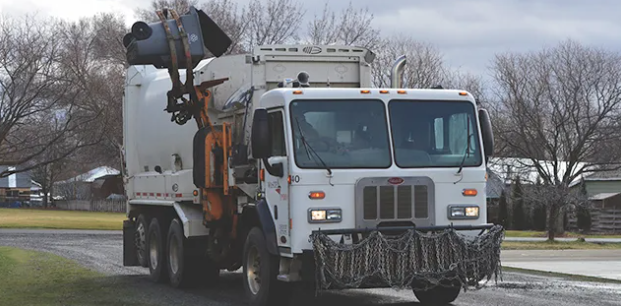
HERMISTON — The state’s curbside recycling program is less than 15 months away from implementation and several questions about the program remain open.
How much will customers pay? What can they recycle? And will the program even get off the ground?
Hermiston Assistant City Manager Mark Morgan said, as it stands now, cities are planning for curbside recycling to begin Jan. 1, 2027.
A potential roadblock is a lawsuit in federal court seeking to block the recycling act the state passed in 2021.
The National Association of Wholesaler-Distributors in July sued the state in U.S. District Court in Portland , claiming the law is unconstitutional because it gives regulatory authority regarding fees and collection to a private entity and not the state.
That private entity is the Circular Action Alliance, a Washington, D.C.-based nonprofit that companies from the food, beverage, consumer goods and retail industries founded.
Despite that suit, Morgan said the state has given cities guidance to continue plans to begin implementing the program.
“Because with these types of things there’s always multiple moving parts and so just because one gear in the system gets locked up it has the potential to lock of up everything so I think the state is figuring, ‘Well, we’re just going to continue, you know, addressing that lawsuit and the meantime people have to start ordering trucks and those types of things so that moves the start date to Jan. 1, 2027,” Morgan said.
But before cities such as Hermiston can move ahead, they must first approve recycling rates that will be charged to customers. And those who are operating the program – Sanitary Disposal in Hermiston’s case – must order new trucks and carts.
The Plastic Pollution and Recycling Modernization Act
The Oregon Legislature in 2021 passed the act requiring all Oregon cities with a population of 4,000 or more to implement curbside recycling. The intent was to establish statewide standards for what can and cannot be recycled and establish new packaging fees for companies that sell products in Oregon.
Those fees, based on the weight and recyclability of the material, are meant to require product manufacturers and distributors to pay some of the costs for disposing of their packaging — costs that are the responsibility of businesses and individuals who have to pay for the garbage.
According to the state, the law aims to make recycling easier for the public to use, expand access to recycling services, upgrade the facilities that sort recyclables and create environmental benefits while reducing social and environmental harms, such as plastic pollution.
Recycling fees and other unknowns
Morgan said Hermiston’s the next step is for the Hermiston City Council to approve recycling rates for customers. Sanitary Disposal will present a recommended rate to the Hermiston City Council sometime this fall.
“It’s going to be an interesting discussion,” he said. “They want to get a rate approved so if and when we actually start providing this service in January 2027 then we’ll be able to start charging.”
Still to be determined are what type of recyclables will be allowed and how many recycling carts will be issued to residents.
Morgan said one thing that won’t be included is yard debris. Residents still will have to dump that in their garbage cans or haul it to Sanitary Disposal’s transfer station.
Entities such as Sanitary Disposal will be responsible for ordering the trucks and carts for curbside recycling, who who pays from that is another question.
“They’re being told by the state to go ahead and start placing orders for the trucks and carts and they’ll be reimbursed by Circular Action Alliance,” Morgan said.
Although whether they will actually get reimbursed is uncertain. The lawsuit could affect who ends up paying for them, Morgan said.
“My big question is let’s assume that everyone approves the rate in November to be effective Jan. 1, 2027, you go buy the trucks, the lawsuit is successful — or whatever — you can’t get reimbursed. Who’s on the hook for paying those? That’s still the question.”
How the curbside recycling program will work
When the curbside recycling program kicks in, Sanitary Disposal will be operating two types of trucks. The standard garbage truck as well as trucks to collect recyclable materials. Morgan said Sanitary Disposal has been doing a lot of work to determine the number of carts and trucks it will need, Morgan said.
Having recycling carts and paying for the service will be mandatory, Morgan said. And while many residents likely will be paying more each month with the addition of recycling carts, some households may end up paying less each month, Morgan said.
“If you think about an individual home, like at my house, we have five people in our household,” he said. “I actually have a 90-gallon cart and a 35-gallon cart. Well, if now I also have a 90-gallon recycling cart, a certain amount of material that was going in the garbage can is now going to go in the recycling can. I will probably cancel that 35-gallon can because I’ll have 90 extra gallons of service. Based on the price they pitched to us for a 90-gallon (recycling) cart, it might be less than the price for the 35-gallon cart. So, I would actually end up saving money and still end up with more gallons of service.”
Morgan said Sanitary Disposal will operate trucks for recycling every other week.
And the curbside recycling law may now affect some residents, depending on where they live.
“What is really going to throw a wrench in things is it’s only required for people who live in the county but inside the UGB. So, if you live out at Hat Rock, they’re not going to get recycling. There’s not even an option for them. It’s going to be up to Ott Road and up to Punkin Center.
Morgan said Umatilla County’s two biggest cities will be top priorities for CAA.
“Umatilla County is the single most impacted county in all of Oregon,” Morgan said. “Hermiston and Pendleton are the two largest communities in Oregon that didn’t already have curbside recycling. Hermiston and Pendleton are like priorities 1A and 1B. Circular Action Alliance is basically saying, ‘You guys are the first to get money for trucks and carts because you don’t already have curbside recycling.’”


Hermiston’s assistant city manager sounds stressed! Multiple moving parts? More like multiple moving gears that could potentially grind to a halt thanks to that pesky lawsuit! Good luck figuring out recycling rates and who pays for the trucks if the whole system gets tangled up. Sounds like a great time to start ordering carts, just in case you get reimbursed… maybe? ♻️
Comments are closed.