





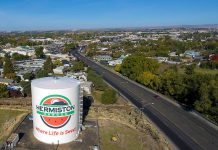




HERMISTON, Ore.-The watermelon harvest, a sweet summer staple in Hermiston, is underway at Walchli Farms.
“You get high-quality sweet melon in Hermiston that you don’t find anywhere else,” said Patrick Walchli.
The bright red and green symbol of Hermiston is being picked, packed, loaded and shipped daily, and the iconic Big Blue Shed at Walchli Farms is open for folks to pick up their favorite variety of melon for snacking and summer events.
Planting
“Hermiston melons are special to me because I grew up here and they remind me of home,” said Elle Blakely, who is spending the summer selling melons at the Big Blue Shed, after selling at markets the previous few years.
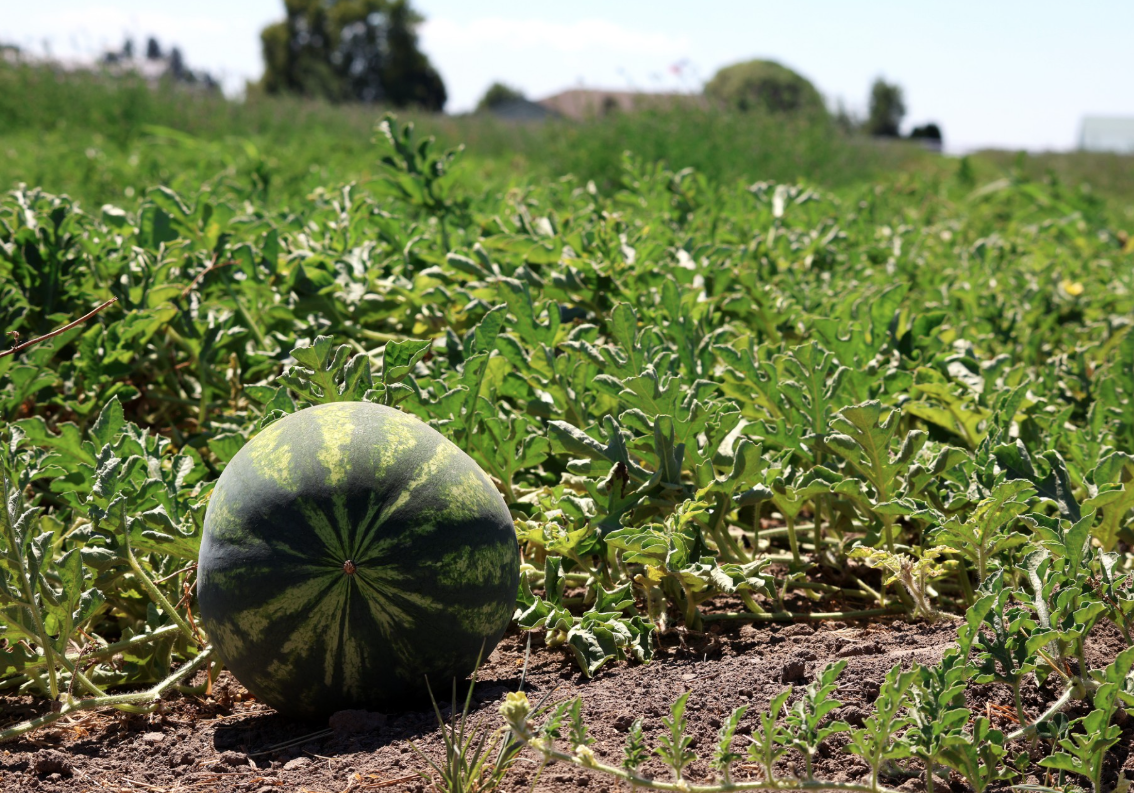
Watermelons are harvested in mid-July, with the season running until about Labor Day, but the process that brings that dark green and rich red melon to your picnic table actually starts in early spring.
Watermelon seedlings are planted by hand in a greenhouse in April before being moved to the fields, where they are hand-planted again, usually over three weeks in early May, so that all plants will come up at the same time.
“When the daytime temperatures and soil temperatures warm up the watermelon really take off,” said Curtis Pederson, Walchli Farms Shop Foreman and son-in-law of the late Skip Walchli, founder of the farm.
Warm days, cool nights and rich soil are a few of the keys to the sweet success of Hermiston watermelons.
“We’ve got the right elevation here where we get hot days, but with the Blue Mountains and the Cascades around us, we get cool breezes at night,” said Pederson. “The soil is also just right for watermelon, with Hermiston being about as far north as they can be grown on a large scale.”
Harvesting
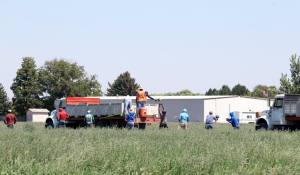
By mid-July the picking crew goes through the fields and cuts the ripe watermelons from the vine before the pitching crew, working four rows deep on both sides of the truck, toss them one at a time from person to person to the truck, where they are hand-stacked.
The pitcher and stacker positions rotate throughout the shift as watermelons are loaded and taken to the processing shed.
The processing shed is where the watermelons are prepared to be shipped to stores and markets before ultimately making it to picnic tables around Hermiston.
Watermelons are dumped onto a conveyor belt that divides the load and sends the melons through a roller brush for cleaning, before they are quickly weighed and stickered with the iconic red Walchli Farms sticker.
“We want people to recognize the brand, not only is this a Hermiston melon, but it’s got that red Walchli sticker,” said Pederson. “It also provides accountability and traceability, there’s a QR code on there that has information about what field that melon came out of and when it was harvested.”
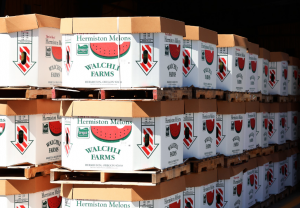
A quality control check weeds out any irregularities before watermelons are placed in white Hermiston Melon bins containing 70, 60, 45, 36 or 25 melons.
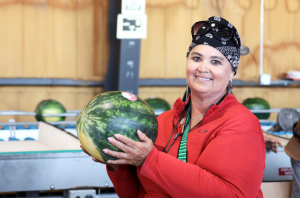
Bins are filled nonstop during the watermelon harvest, then loaded onto trucks for distribution to WinCo, Fred Meyer, Walmart, Safeway and Costco stores, as well as Harvest Foods in Umatilla.
Walchli melons are also sold at farmers markets across the Pacific Northwest, including the Seattle, Portland and Boise areas, with sellers and peddlers filling up trucks, trailers and even minivans with watermelons to sell, according to Pederson.
Now in full swing, the watermelon harvest will stretch into early October, although demand tends to wane when jacket weather comes around, typically around Labor Day.
“It’s always a challenge for farmers to outrun the expenses of everything from the crops and labor to maintenance, electricity and shipping by Labor Day,” said Pederson.
History
From humble beginnings to hundreds of acres, 2025 marks the 69th summer that Walchli watermelons will be harvested.
Walchli Farms started in the spring of 1957 when Skip Walchli planted watermelon on 10 acres of rented land and borrowed his father’s truck at harvest time, loading it up and working his way to the Oregon coast, selling melons along the way.
“Since then he raised more crops, bought land, built a name and an empire,” said Pederson of Walchli, who passed away in 2019.
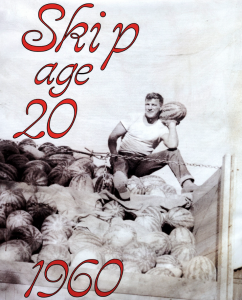
The Walchli Farm now spans roughly 2,500 acres, with watermelon grown on about 300 of those.
Famous for its watermelon, the fourth-generation family farm also grows asparagus, corn, tomatoes, peppers, zucchini, cucumbers, cantaloupe, potatoes, wheat and hay.
“We’re grateful for the Hermiston community and thankful that we can carry this mantle forward,” said Patrick Walchli.
Hermiston watermelon
Walchli Farms grows watermelon, seedless watermelon, orange watermelon, yellow watermelon and the coveted Black Mamba Watermelon.
“It’s a Hermiston staple and I think it’s the sweetest you can find,” said Cozette Cooley, who is spending her second summer working at the Big Blue Shed.
Part of the mystique of the iconic Hermiston watermelon is that everyone who enjoys the sweet treat looks for something different, with some wanting a darker or lighter melon, and others looking for scarring from sitting in the field as an indicator of ripeness.
“You want a melon that’s heavier than it looks when you pick it up,” said Pederson. “There’s lots of tiny water pockets in there, and you want them to be full and tight.”
There’s a fine line between underripe, perfect and over-ripe when it comes to watermelon, according to Pederson, and one indicator of a good one is whether it has a nice “ping” sound to it when gently slapped with an open palm.
Hermiston will celebrate all things watermelon at Melon Fest on August 16, and melons and other fresh produce are available at the Big Blue Shed at the Walchli Farm located at 32697 East Loop Road from 7 a.m. to 6 p.m. daily.