











HERMISTON, Ore.-March is National Colorectal Cancer Awareness Month, a time to raise awareness about the disease, highlight the treatment and resources available after diagnosis, and to promote screening and early detection.
“By continuing to support research, raising awareness of risk factors for the disease, promoting the widespread adoption of regular screening, and encouraging everyone to exercise regularly, we can save thousands of lives each year and dramatically reduce the risk of colorectal cancer,” former President Bill Clinton establishing Colorectal Cancer Awareness Month by Presidential Proclamation in February 2000.
According to the American Cancer Society (ACS), there will be about 108,860 new cases of colon cancer and about 49,990 new cases of rectal cancer in 2026, resulting in about 55,230 deaths nationwide.
Despite the sobering statistics, colorectal cancer is very treatable with a high survival rate when detected early.
Colorectal Cancer
Colorectal cancer is cancer that starts in either the colon or rectum and can spread to other parts of the body.
The large intestine, made up of the colon, rectum, and anus absorbs water and electrolytes from liquid waste from the small intestine, and when healthy, the colon then forms a solid stool, which moves to the lower colon and rectum before being released through the anus.
According to Board-Certified Gastroenterologist Dr. Joyce Koh with Good Shepherd Health Care System in Hermiston, when cells in the body change or become damaged, unhealthy or abnormal, cancer cells are created. When this happens in the colon or rectum, the abnormal cells form a cancerous mass or tumor.
“The cancerous mass can invade through the colon wall and spread into surrounding body parts or into the bloodstream,” said Dr. Koh. “The mass can crowd out the normal cells in the large intestines or other parts of the body and make it so that those body parts can no longer function normally.”
Colorectal Cancer risk factors
Colorectal Cancer is the fourth most common cancer among men and women combined, and each year about 150,000 Americans are diagnosed with the disease.
Over the course of their lifetimes one in 25 men and one in 26 women will develop colorectal cancer, according to the National Cancer Institute, with factors such as age, race, sex and family history all increasing the risk.
According to the ACS, cases of colorectal cancer are rising in people under 65, particularly among younger adults.
While the exact reason for the rise of colorectal cancer among younger adults is not known, several factors could be contributing to the spike, including the lack of physical activity, excess weight, diet, or environmental factors, such as microplastics or other forever chemicals.
“There are multiple things that can increase your risk of colorectal cancer,” said Dr. Koh. “Some of them can’t be changed or controlled, but many can be reduced or eliminated.”
While factors such as age, race, sex and family or prior history can’t be helped, other health and lifestyle changes can reduce the risk of colorectal cancer.
Better control of Type 2 diabetes and body weight management can reduce the risk of colorectal cancer, as can smoking and our diets.
According to Dr. Koh, red meat, processed meat, as well as fried, charred and grilled meats can increase the risk of colorectal cancer, as can alcohol and added or processed sugars.
Symptoms and screening
Since colorectal cancer often has no identifiable symptoms and often goes undetected, screening and early detection is essential.
“Early colon cancer may have no symptoms or signs,” said Dr. Koh. “That said, if you have unexplained symptoms or changes that go on for more than two weeks, you should see your healthcare provider.”
Changes that could be warning signs for Colorectal cancer
- Changes in bowel habits: Going more or less frequently or feeling like you need to but can’t
- Changes in stool: Black, bloody, thin or loose stools could indicate a problem
- Abdominal pain, cramping or discomfort
- Bloating
- Vomiting
- Loss of appetite
- Weight loss without dieting
Individuals at average risk of colon cancer should start screening at 45, while the age to start screening for those at increased risk varies.
Those with a family history of colon cancer or colon polyps are considered to be at increased risk and when to start screening depends on an individual’s particular risk factor, with Dr. Koh recommending that anyone with a first-degree relative, such as a parent or sibling, who experienced colon cancer start screening when they turn 40, or 10 years before the age at which their relative was diagnosed.
“Screening is a key part of staying healthy,” said Dr. Koh. “Finding cancer early through screening increases the chances of curing the disease, and the possibility of life-extending treatment.”
For those at average risk, with no symptoms or family history of colorectal cancer, visual, stool and blood tests are available for routine screening.
Visual tests
- Colonoscopy: A colonoscopy is a visual procedure during which a colonoscope with a video camera on the tip is used to examine the inside of the colon and is considered one of the most comprehensive methods of colorectal cancer screening, allowing a healthcare professional to identify and remove precancerous polyps from the colon.
- CT Colonography: A virtual colonoscopy that uses a CT scan to take cross-sectional pictures that are then put together for a complete view of the colon and rectum.
- Sigmoidoscopy: A sigmoidoscope is inserted into the colon to look for polyps, growth or other abnormalities. If any abnormalities are detected a doctor may then order a colonoscopy for the patient.
Stool Tests
- Fecal Immunochemical Test, Guiac Stool Card Test, ColoGuard and ColoSense: Noninvasive at-home options for colorectal cancer screening where a stool sample is collected and mailed to a lab for testing.
Blood Tests
- Shield Test: A blood test intended to detect cancer in those at average risk for the disease. Available by prescription only.
- Coloheatlh: Blood test that detects a DNA biomarker linked to colorectal cancer.
Before getting screened, it’s best to consult your healthcare provider about your personal risk factors and what testing method would be best.
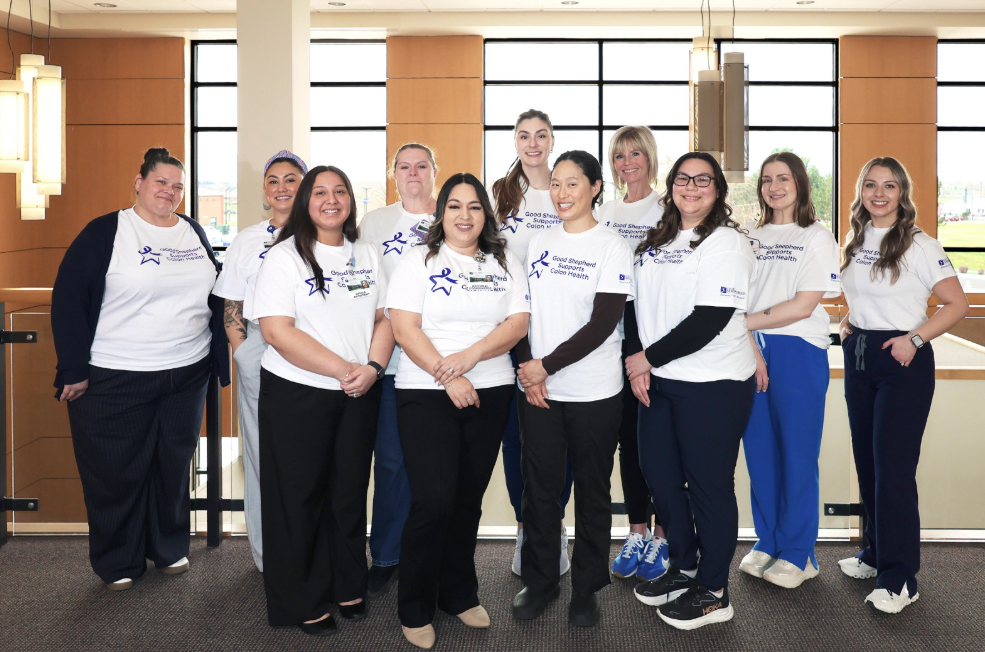
Good Shepherd Gastroenterology, where Dr. Koh and Nurse Practitioner Catherine Spomer practice, can help patients take the next step in their gastrointestinal health, including determining which testing or treatment options to pursue.
Diagnosis and Treatment
A cancer diagnosis can be scary, but when colorectal cancer is detected early, the five-year survival rate is about 90 percent or higher, according to the ACA.
After a colorectal cancer diagnosis, treatment depends on the stage of the cancer and the individual patient, with options often including surgery, chemotherapy, radiation, and immunotherapy or targeted therapy.
“Here at Good Shepherd, we have expert oncologists and surgeons, and a cancer treatment center dedicated to your care. They form the cornerstone of colorectal cancer treatment,” said Dr. Koh. “Even with cancer, your surgeon may be able to utilize robotic surgical techniques, which enhance your recovery, and the oncologist may end up prescribing more ‘precise’ medicines that target specific mutations or which help your own immune system fight cancer cells.”
More information about the Good Shepherd Cancer Center, located at 620 NW 11th Street, Suite M-102 in Hermiston, is available online or by calling 541.667.3615.
Colorectal Cancer Resources
The Colorectal Cancer Alliance (CCA), the nation’s leading nonprofit dedicated to colorectal cancer and has been working to build programs to support patients, increase screening rates, and accelerate research since 1999.
Resources for those with colorectal cancer and their families available through the CCA, Colon Cancer Coalition, American Cancer Society, and many other local health organizations around the country include online support communities, buddy programs, and events to raise awareness, such as runs and walks.
Resources about cancer control and prevention, including colorectal cancer in Oregon are available through the Oregon Health Authority.
Good Shepherd Gastroenterology is located at 620 NW 11th Street, Suite M-202 in Hermiston and can be reached at 541.667.3804. Appointments may also be requested online.