









SALEM, Ore.-Any legal weapon deer season starts in Oregon on October 3, and the Oregon Department of Fish and Wildlife (ODFW) is increasing monitoring for Chronic Wasting Disease (CWD) across the state.
CWD is spread through direct contact with an infected animal or by environmental contamination and is fatal to deer, elk, and moose.
According to ODFW, CWD has never been detected in Oregon, however, it has been detected in Washington, Idaho, and California and all successful deer and elk hunters in Oregon are asked to turn in a CWD sample.
“With CWD detected in almost every bordering state, it is more imperative than ever for hunters to provide our unique contribution toward CWD detection and surveillance by voluntarily submitting samples from our harvested deer and elk,” said OHA Conservation Director Tyler Dungannon.
Sampling involves collecting lymph nodes and hunter details and can be done in about 10 minutes, according to ODFW.
For each sample submitted between Aug. 1, 2026, and March 31, 2027, hunters will earn one entry into a drawing for a Howa 1500 .223 caliber rifle courtesy of the Oregon Hunters Association.
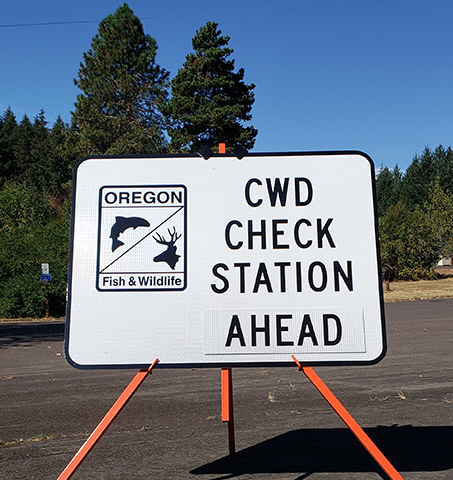
Samples can be submitted for CWD testing at ODFW check stations, at participating taxidermists or meat processors, by appointment at an ODFW office, or by dropping the head of the deer or elk in an after-hours collection bin at certain ODFW offices.
“Early detection is our best tool in reducing the disease’s impact on Oregon’s deer, elk, and moose populations,” said Ashley Reeder, ODFW’s CWD Surveillance Coordinator.
A list of check stations, ODFW offices, and participating taxidermists and meat processors is available online through ODFW.
ODFW has tested more than 40,000 samples from hunter-harvested, road-killed, and other deceased animals for over 20 years without finding any cases of CWD in Oregon to date.
According to ODFW, a new in-state testing facility at the Oregon State University Veterinary Diagnostic Laboratory will reduce the turnaround time for CWD test results and the amount of time hunters must wait for results, while increasing the speed the state can respond to any CWD detection.