






BOARDMAN, Ore.-The Boardman Fire Rescue District (BFRD) has a new tool at its disposal to help keep residents of Northeast Oregon safe.
BFRD is the first department in the state to have specialized grain rescue equipment to be used in an emergency situation involving someone falling into grain in a bin or silo.
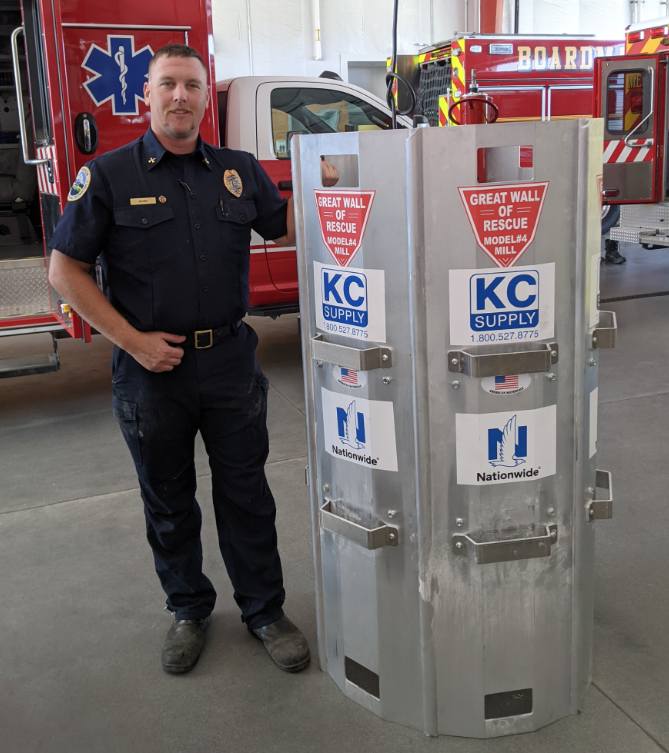
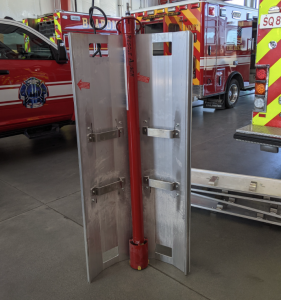
The grain rescue equipment, known as the “Great Wall of Rescue” consists of six metal panels that can be connected to form a tube around someone who has fallen into grain.
Once the metal panels are in place around the victim, a drill-powered auger is placed into the tube to auger grain out at a rate of about a bushel a minute, until the grain is low enough for the person to grab onto a bar placed between openings in the top of the panels.
While BFRD Battalion Chief Sam Irons isn’t aware of an incident of someone falling into a silo and needing to be rescued in the area, he knows that grain industry accidents are prevalent nationwide.
“We’d rather have this equipment and not need it than need it and not have it,” said Irons, who applied for a grant for the equipment provided by Nationwide Insurance, before Morrow County Grain Growers (MCGG) decided to purchase the equipment and donate it to BFRD.
Grain bin safety
Nationwide Insurance has held “Grain Bin Safety Week” annually during the third week of February since 2014.
Part of Nationwide’s safety week efforts include providing opportunities for rural fire departments to acquire grain rescue equipment and training.
In 2022, there were 42 reported grain entrapments across the country, 15 of which were deadly, followed by 27 reported entrapments in 2023, according to the Summary of U.S. Agricultural Confined Space-Related Injuries and Fatalities, published by Purdue University.
“A lot of these accidents aren’t commercial, it’s farmers,” said Irons. “It’s local or regional farms that maybe don’t have automated safety processes in place.”
Grain bin safety hasn’t been too much of an issue in Northeast Oregon, something Kevin Gray, General Manager of MCGG, attributes to the local wheat being harvested when it’s warm, which keeps the moisture down.
“Where engulfments can happen is when grain gets out of condition, meaning the moisture levels are too high,” said Gray. “If it isn’t dried down far enough or soon enough, a crust can form, then when someone walks on it, they hit an air void underneath and fall through.”
According to the Confined Space-Related Injuries report, an adult who falls into flowing grain can become fully engulfed in just 20 seconds.
Gray was aware of the rescue tubes from spending time in the Midwest, and MCGG facilitated the purchase of the grain rescue equipment from Nationwide for BFRD.
MCGG went “above and beyond,” according to Irons, ensuring BFRD got not only the metal sheets, with a price tag of about $3,000, but the auger that cost around $2,000 as well as the mobile platforms for firefighters to stand on during rescues.
Training
The National Education Center for Agricultural Safety (NECAS), in Peosta, Iowa, led a training on the grain rescue equipment at the Port of Morrow on August 14.
The training attended by BFRD firefighters, volunteers with Lexington Fire, MCGG employees and local co-ops, included both classroom instruction and a simulated grain rescue, and was the farthest west ever offered by NECAS.
“It’s good training to have,” said Irons. “Hopefully we never have to use it, but it’s good to be ready.”
There are always variables in an emergency, including when a call comes in and the location of the incident, but the “Great Wall of Rescue” can be assembled in one to three minutes, once firefighters are on scene, according to Irons.
A good tool to have
While BFRD may be the first department in Oregon to have grain rescue equipment, they are quite willing to share the wealth with neighboring departments and Counties, should an emergency arise.
“With the amount of wheat and corn harvested in Morrow, Gilliam, Umatilla and Grant Counties, there’s always the potential for an emergency situation,” said Irons. “This rescue equipment will absolutely benefit Northeast Oregon.”
Irons is now working on developing Standard Operating Procedures for the use of BFRD’s new grain rescue equipment, running through different scenarios, such as response times, confined space rescues, air monitoring, ventilation, sharing with other Counties and departments, and more.
“With its location and personnel, we felt Boardman was a good spot for this donation,” said Gray. “We’re happy that BFRD agreed to be the recipient of this grain rescue equipment.”