










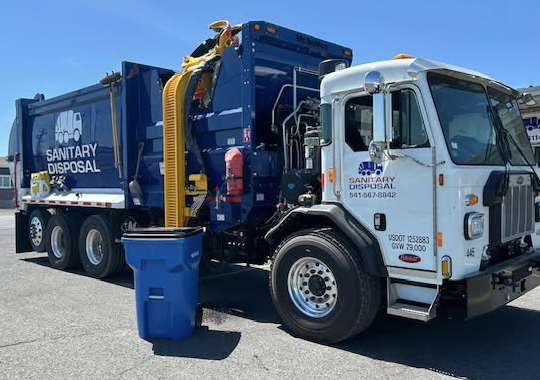
HERMISTON, Ore.-Curbside recycling started three months ago in Hermiston and other Eastern Oregon cities.
While implementation of the service may have been a little rough, especially concerning the cost, what can be recycled, and the pickup dates, residents are now getting into the routine of the curbside service.
“This is a great opportunity to access recycling resources that have never been available in Eastern Oregon before,” said Jessica Portillo, Outreach Coordinator with Waste Connections. “We’re excited to help people understand the process and get on board.”
Curbside recycling comes to Hermiston
Oregon’s Plastic Pollution and Recycling Modernization Act (SB 582) passed in 2021, mandating that all cities with at least 4,000 residents must provide curbside recycling services.
The law calls on local governments, beginning in 2026, to implement curbside recycling programs, and ensures that producers of packaging and paper products share the cost of recycling.
Hermiston City Council approved a standard monthly rate of $8 for curbside recycling, with a low-income rate of $6.80 per month available to qualifying households in November of 2025.
Recycling carts and packets explaining what can be recycled were distributed to residents in June, and curbside recycling officially began on July 6, with 95-gallon recycling carts picked up every other week on the same day as residents’ garbage is collected.
“Curbside recycling has been a learning curve for everyone, including Sanitary Disposal,” said Portillo. “We’re learning how the operation works, while teaching people how to better recycle.”
Sanitary Disposal was inundated with calls when curbside recycling began in July, with the most common issues including the cost, confusion about what could be recycled, and residents who said they didn’t ask for the cart and don’t plan to use it.
For Portillo, who comes from a recycling background, and is passionate about the subject, the feedback about the rollout of curbside recycling is important, serving as an opportunity to further educate the community about recycling.
“I’m excited, each of those calls, and talking to people in the community with questions or concerns is an opportunity to really explain why we’re recycling, or why certain things can be recycled and others can’t,” said Portillo. “People really appreciate the ‘why’ language.”
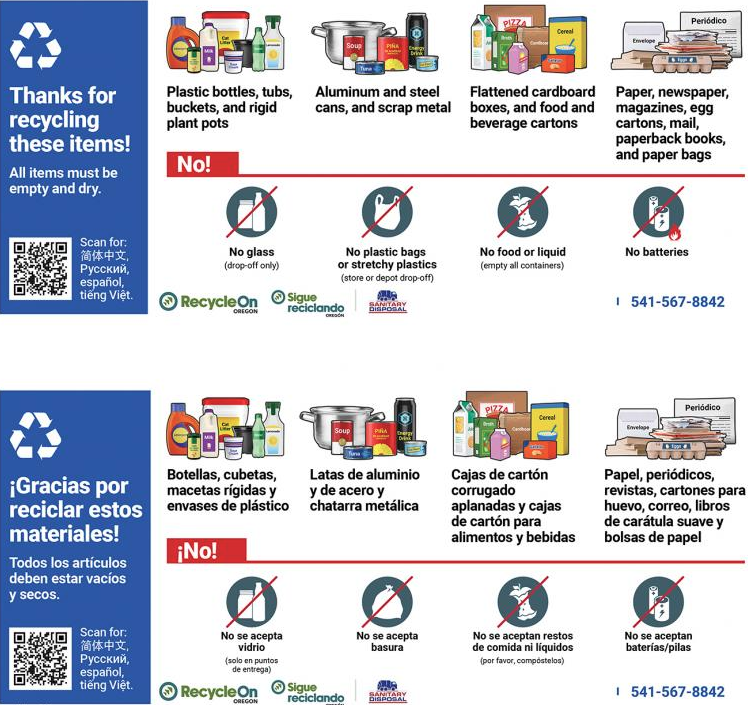
Under Hermiston’s curbside recycling program, plastics, metal, cardboard and paper are accepted. All items should be commingled in the same cart and should not be put in a bag before being put in the cart.
“Anything that goes into the cart should be empty, clean and dry, and all boxes should be flattened,” said Portillo, noting that items, such as pizza boxes should be at least 90% clean if they are going to be recycled.
Plastic bags, styrofoam, frozen food boxes, to-go containers and glass, are a few things that should never go in the recycling cart.
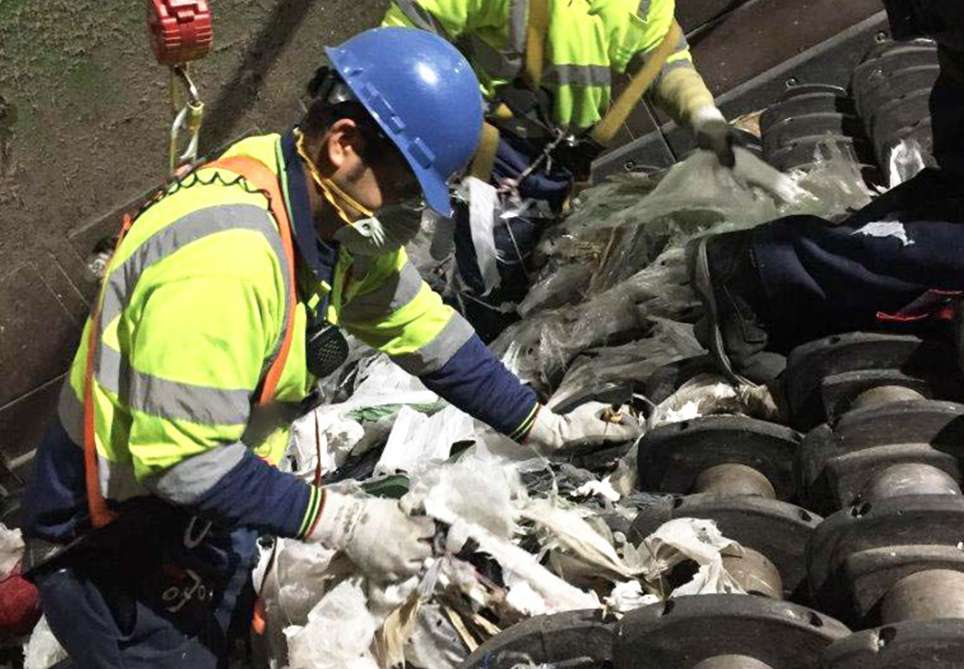
Plastic bags can get caught in the sorting machines at recycling facilities, damaging machines and endangering workers, while styrofoam is hard to sort and can break into lots of tiny pieces that can turn into litter.
Frozen food packaging is produced with a plastic coating, which makes them unrecyclable, as they don’t break down easily.
To-go food containers should also be left out of the recycle cart, according to Portillo, since they are all made a little differently and are coated with plastic or wax, which make them difficult to separate from paper during recycling, and while some may be compostable, they might not be recyclable.
Glass can’t go in the curbside recycling cart for the obvious reason that it breaks, can spread when it shatters and can be dangerous, however, residents can still drop glass bottles and jars off at the RecycleOn Center at Sanitary Disposal.
“The simplest thing to remember is if you don’t see it on the printouts, it doesn’t go in the recycling,” said Portillo.
Lists of items that can be recycled were distributed to households in Hermiston when curbside recycling began and are available online through RecycleOn and the City of Hermiston.
From Hermiston to Clackamas and beyond
In Hermiston, Sanitary Disposal collects recyclable materials curbside and takes them to the transfer station on Highway 395.
According to Portillo, rural areas used to be at a disadvantage when it came to recycling because sorting facilities were so far away, however, the Opportunity to Recycle Act now provides funding for transporting recyclable material.
“All the recycling that’s collected in Hermiston is put together at Sanitary Disposal then transported to the Portland area, dumped on conveyor belts and sorted,” said Portillo.
Hermiston’s recycling is transported to Pioneer Recycling Services in Clackamas, Oregon, where the sorting process involves a maze of machinery and technology.
2D products, such as paper and cardboard, as well as 3D products, like cans and bottles are sorted, and magnets pull metal objects.
People are also an integral part of the sorting process, as different types of plastic, such as containers with volume to them that can be flattened may confuse the sorting machines, while thicker plastic may be recognized by machines.
“People are the first line of defense,” said Portillo, of the recycling service employees on either side of the conveyer belts. “There’s a lot of moving parts as items are separated by people, machines, and technology.”
Once all the recyclables are sorted, they are baled up and shipped out to responsible end market producers to be made into new items.
The future of curbside recycling
For Portillo, continued education and outreach about recycling, including what can be recycled and how the process works is important, especially regarding common misconceptions, such as that recycling ends up in landfills.
“Curbside recycling is a state mandate,” said Portillo. “The program is watched closely and monitored.”
While not required yet, curbside recycling may also expand to multi-family dwellings, such as large apartment complexes in the next few years, as the Department of Environmental Quality (DEQ) works out a plan to implement the service by 2028.
At Sanitary Disposal in Hermiston, a compactor for the new curbside recycling program has been approved and is expected to be operational by mid-January 2027.
“This project will give us the processing capacity needed to handle the additional recyclable material generated through the recycling expansion efforts across our service area,” said Kevin Miracle, Sanitary Disposal District Manager.
Sanitary Disposal is also planning to build a cover over the recycling compactor area by late next year.
“This improvement will help protect recyclable materials from the weather, improve processing efficiency, and create a safer working environment for employees,” said Miracle.
Recycling tips
According to Portillo, a few simple tips can ensure effective recycling.
- Know accepted items: Different areas accept different items so familiarize yourself with what’s accepted in your region
- Empty and Dry: Make sure the items put in your recycling cart are empty and dry
- Flatten boxes: Save space and make collection easier by flattening cardboard boxes
- Lids and caps: Lids and caps are alright if screwed onto plastic bottles
- No small items: Items must be larger than two inches by two inches to be recycled
- Know what to throw: Only put recyclable items in the curbside cart. When in doubt, throw it out
- Clean paper and cardboard: Remove greasy food or stains before recycling
- No sharp objects: Sharp materials are hazardous to workers
- Keep glass separate: Use a separate bin for glass and bring it to a drop-off recycling center
- No bags: Keep recyclable items loose
RecycleOn.org is a good resource for curbside recycling information in Eastern Oregon and includes an FAQ section.
Information on curbside recycling is also available through Sanitary Disposal and the City of Hermiston.
“The amount of recycling we’ve seen in the first few months is exciting and shows that curbside recycling is becoming part of the routine,” said Portillo.