










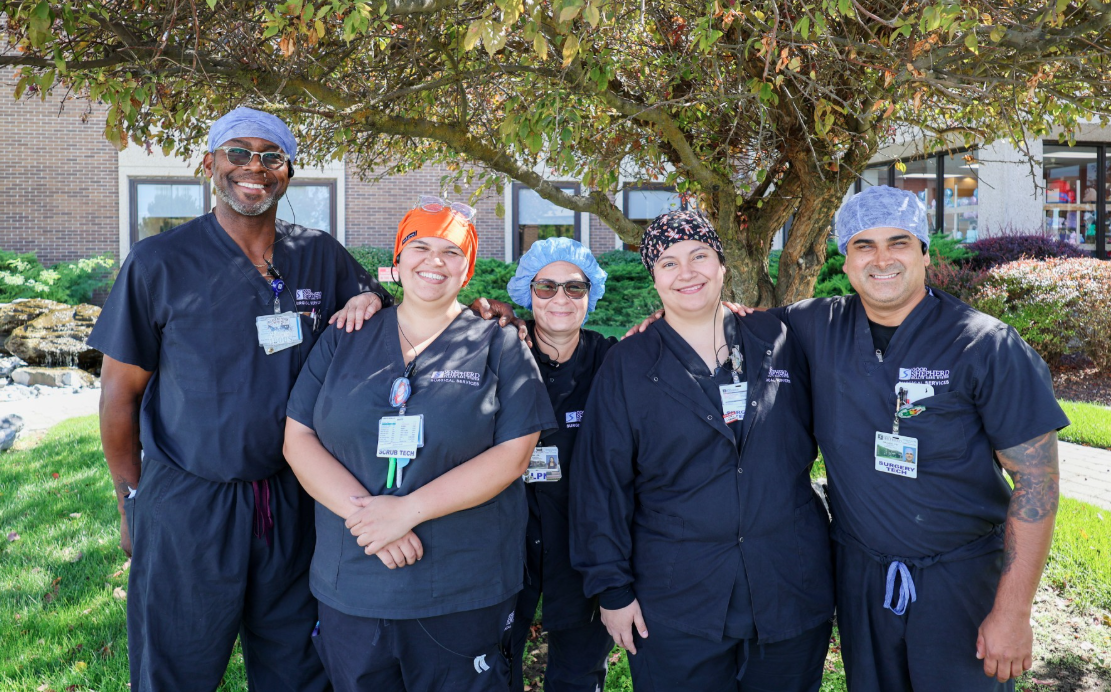
HERMISTON, Ore.-National Surgical Technologists Week is September 20-26.
Established in 1984, National Surgical Technologists Week highlights the essential role they play in maintaining sterile technique, preparing operating rooms, and supporting surgeons in hospitals nationwide.
Surgical Technologists are healthcare providers who support surgeons, nurses, and other providers during surgery, setting up surgical instruments and helping protect patient safety, according to the Cleveland Clinic.
At Good Shepherd Health Care System (GSHCS) in Hermiston, Surgical Technologists work to make operating rooms sterile and efficient, while ensuring patient safety.
“We’re the people behind the scenes in the operating room,” said Otis Hopkins, a Surgical Technologist at GSHCS. “We basically ensure things are safe, organized, and efficient.”
Surgical Technologists are one of five team members, along with the anesthesiologist, nurse, doctor, and an assistant, present during surgery.
Patient safety and surgical success starts with meticulous preparation from Surgical Technologists, including sterilizing instruments and ensuring the correct personal protective equipment (PPE) is worn in the operating room, counting instruments, and, ultimately, assisting the surgeon during the procedure.
“We make sure all the needed equipment is working and ready, then we pass instruments to the surgeon and monitor the patient during the procedure, making sure there’s no break in sterility,” said Hopkins. “All these things make a difference in an organized, safe surgery, and we’re directly responsible for those outcomes.”
For Hopkins, one of the challenges of being a Surgical Technologist is learning the individual preferences of the doctors he works with.
The instruments they use and the names they have for them can vary from doctor to doctor, so getting to know the doctor’s personality, as well as medical procedures, is essential.
“I love being able to anticipate, knowing what instrument the doctor will ask for without them saying anything,” said Hopkins. “I also have to know anatomy, physiology, and have an understanding of the procedure being done.”
A successful surgery is a non-eventful one, for both the patient and medical staff. Being part of a team with a shared goal and achieving that successful outcome is the most rewarding part of his job, according to Hopkins.
Surgical Technologists are also advocates for their patients, and patient communication skills are something Hopkins has learned and developed throughout his career.
For Hopkins, this means anything from walking a patient through a procedure if they are nervous, to getting warm blankets for them afterward.
“All these things make a difference,” said Hopkins. “Patient care doesn’t end when they leave the Operating Room.”
Becoming a Surgical Technologist
Employment of Surgical Technologists grew at a rate of 12 percent between 2016 and 2026, with over 110,000 Surgical Technologists employed in the United States, as of 2024.
Four or five of the Surgical Technologists at GSHCS are travelers, and the only nearby school with a Surgical Technologist program is Columbia Basin College (CBC) in Pasco, Washington.
Students in the Surgical Technologist program at CBC spend six weeks at GSHCS, and Hopkins spends a lot of time training the next generation.
For those interested in pursuing a career as a Surgical Technologist, Hopkins recommends getting into a hospital setting, if possible, perhaps as a job shadow experience, then more training and getting certified as a first assistant.
“It’s a great time to come into a growing industry,” said Hopkins. “With all of the technology, minimally invasive surgery, and surgical robotics, it’s a great opportunity to be an active participant in the growing surgical field.”
In addition to training and education, communication and interpersonal skills, including speaking with patients and being comfortable around doctors, are important attributes for those pursuing a career as a Surgical Technologist, according to Hopkins.
Surgical Technologists at GSHCS
Hopkins originally wanted to be a firefighter, however, after narrowly failing the entrance exam twice, he started exploring other career options in college.
Hopkins’ mother worked in healthcare and after talking with some nurses in college, he enrolled in a Surgical Technologist program, finding a career path that suited him right away.
“The first day in class, I knew this is what I wanted to do for the rest of my life,” said Hopkins. “You’re in the surgery room working with patients and doctors, and there’s lots of flexibility.”
Hopkins has now been with GSHCS for 12 years and has experienced the constant quality of care, as well as the expansion of technology and services for patients.
GSHCS is home to a 25,000 square foot state-of-the-art Surgical Services facility that features eight surgical robots, making it one of the most technologically advanced Critical Access Hospitals (CAH) in the nation.
“Doctors come here to work with our robots, and patients from all over the world come here for our medical staff and for their treatment,” said Hopkins. “We’re constantly opening up more services to accommodate the region and beyond.”
Hopkins also appreciates the fact that GSHCS invests in its employees, with employer-paid medical insurance and an onsite childcare center.
“Good Shepherd is like no other place, I’m not going anywhere else,” said Hopkins. “The culture they’re creating is amazing.”