










HERMISTON, Ore.-May is National Mental Health Awareness Month, a time to increase the understanding of mental illness, highlight the realities of living with conditions, promote strategies for mental wellness, and reduce the stigma of mental illness.
Mental Health America (MHA), the leading nonprofit dedicated to mental health well-being and prevention, founded Mental Health Month in 1949.
Initially only a week-long observance, advocacy efforts have expanded through the years to become a month-long observance.
The 2026 Mental Health Awareness Month theme is: “More Good Days, Together, which encourages everyone to reflect on what a good day looks like, individually and as a community,” according to MHA.
Mental health in Oregon
According to the Centers for Disease Control and Prevention (CDC), the country is experiencing a mental health crisis affecting Americans of all ages.
Over 236,000 adults in Oregon (total population of 4.27 million in 2025) have a serious mental illness, according to the National Alliance on Mental Illness (NAMI).
However, many mental illnesses go undiagnosed or untreated due to barriers to access for care, including a lack of providers in an area, the cost of treatment, and the stigma of mental illness.
According to NAMI, over 1.3 million people live in communities in Oregon that do not have enough mental health professionals to serve the population, with 291,000 adults in the state reporting that they needed mental health treatment but did not receive it in 2018-2019.
Mental health is not easily defined, which may contribute to its lack of treatment.
According to Psychiatrist Dr. Christopher David, with Good Shepherd Health Care System in Hermiston, mental health can generally be defined as “the status of how your inner world is doing – the way your mind handles stress, emotions, relationships, and the ins and outs of everyday life.”
Good Shepherd Psychiatry
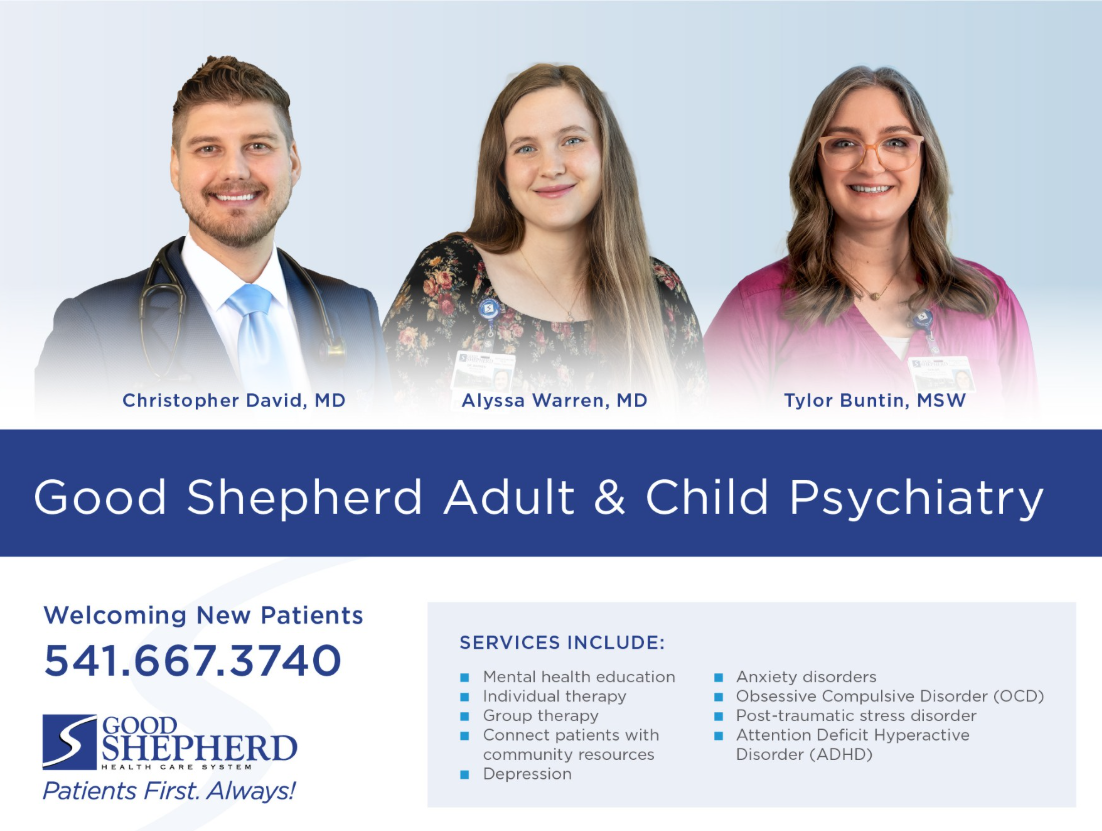
Dr. David joined GSHCS in the fall of 2024 to build the hospital’s mental health program, which provides comprehensive on-site mental health psychiatry services for both adults and children.
“It has been an honor to build out the outpatient psychiatry clinics and deliver a model of care that represents the highest levels of quality psychiatric care available,” said Dr. David.
Dr. David and Dr. Alyssa Warren, with Good Shepherd Psychiatry, treat many psychiatric conditions, including depression, anxiety, trauma, ADHD, OCD, psychosis, mood disorders, and substance use disorders on an outpatient basis.
“We have a multi-disciplinary team that can offer comprehensive evaluations, medication management by board certified physicians, in-house 1:1 psychotherapy as well as in-house group therapy programs,” said Dr. David.
Psychotherapy is often recommended as an intervention before medication is prescribed, according to Dr. David, and Good Shepherd Psychiatry works collaboratively with in-house therapists to care for patients dealing with a mental health issue.
“Even in our psychiatric management appointments, we always integrate psychotherapy into every visit,” said Dr. David. “We take considerable time, over many hours, to first get to know the whole person, in all their complexities, before developing a collaborative treatment plan.”
Misconceptions about mental health
National Mental Health Awareness Month is about increasing understanding and raising awareness about mental health.
While mental health conditions are becoming more understood, misconceptions persist, often leading to a stigma concerning getting treatment.
One misconception is that mental health problems are rare and only affect unwell people.
“In actuality almost everyone, across ages and demographics will experience very serious challenges with stress, anxiety, burnout, or grief at some point in their lives,” said Dr. David.
Another common misconception is that mental health only affects adults. According to Dr. David, children and teenagers both experience many mental health challenges, including anxiety, depression, and trauma.
More Good Days, Together
The 2026 Mental Health Awareness Month theme is: “More Good Days, Together, which encourages everyone to reflect on what a good day looks like, individually and as a community, according to MHA.
When it comes to being aware of our own mental health, objective data can be helpful, according to Dr. David, who recommends tracking your sleep, mood, your minutes of activity, and limiting screen time every day.
“Our restful sleep is the foundation to everything else we do, think about, and process during our waking hours,” said Dr. David, who recommends improving sleep architecture with consistent bedtime and wake-up times and keeping noise and light to a minimum at night.
Personal connections and community involvement are also critical to maintaining mental health, especially in the digital age, when screens are so prevalent.
According to Dr. David, it’s critical to constantly assess how we are connecting and to remain close with those around us who we can share thoughts and ideas with, and who can help us through difficult times.
“This is one of the most essential components of feeling fulfilled and whole in our lives, and it has become an increasingly challenging area, particularly for young people, who have grown up for generations with screens in their pockets,” said Dr. David.
With a little over a week of National Mental Health Awareness Month left take some time to put the screen down and think about what a good day looks like in your life, then consider sharing that day with someone else.
Good Shepherd Psychiatry is located at 600 NW 11th Street, Suite E-33, in Hermiston and can be reached at 541.667.3740.
More information on Good Shepherd Psychiatry is also available online.